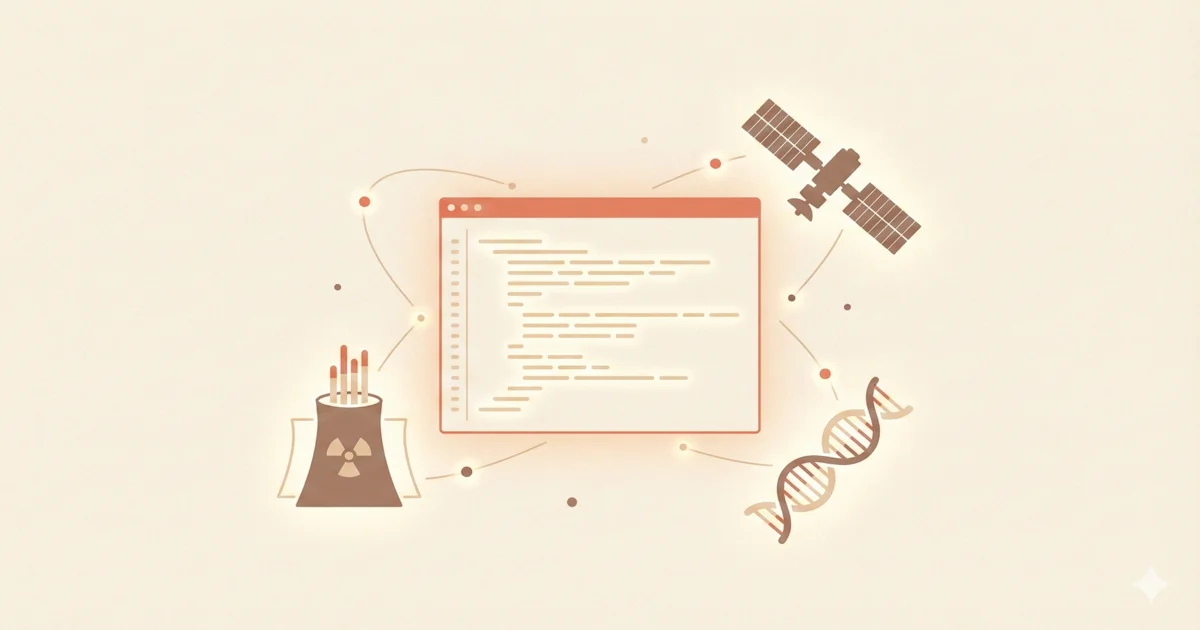
MIT Technology Review just placed AI-powered coding alongside nuclear reactors, gene editing, and commercial space stations.
In the 25th anniversary edition of their legendary 10 Breakthrough Technologies list, "Generative Coding" earned a spot—not as a curiosity or emerging trend, but as a technology that will "drive progress or incite the most change." This is the publication that identified CRISPR years before it transformed medicine and called mRNA vaccines transformational before the pandemic made them household names.
When MIT TR speaks, the industry listens. And right now, they're saying AI coding has arrived.
The Full 2026 Breakthrough Technologies List
MIT Technology Review's selection process is rigorous. They don't chase hype. They identify technologies at inflection points—mature enough to demonstrate real impact, transformational enough to reshape industries.
Here's what made the cut for 2026:
| # | Technology | Category |
|---|---|---|
| 1 | Sodium-ion batteries | Energy |
| 2 | Generative coding | AI/Software |
| 3 | Next-generation nuclear | Energy |
| 4 | AI companions | AI/Consumer |
| 5 | Base-edited baby | Biotech |
| 6 | Gene resurrection | Biotech |
| 7 | Mechanistic interpretability | AI/Research |
| 8 | Commercial space stations | Space |
| 9 | Embryo scoring | Biotech |
| 10 | Hyperscale AI data centers | AI/Infrastructure |
AI's Unprecedented Dominance
Four of ten breakthrough technologies are AI-related. This has never happened before in the list's 25-year history. Generative coding, AI companions, mechanistic interpretability (Anthropic's AI transparency research), and hyperscale AI data centers represent a coordinated shift in how technology is developing.
The message is clear: AI isn't just one technology among many. It's the infrastructure layer on which the next decade will be built.
The Numbers That Convinced MIT
MIT Technology Review doesn't make these selections based on marketing pitches. They cite hard numbers from the CEOs of the world's largest technology companies.
Big Tech's AI Code Statistics
| Company | Claim | Source | Executive |
|---|---|---|---|
| Microsoft | 30% of code is AI-written | CNBC | Satya Nadella |
| 25% of code is AI-generated | The Verge | Sundar Pichai | |
| Meta | Target: "most code" AI-written in 12-18 months | Engadget | Mark Zuckerberg |
These aren't startup pitches or research projections. They're statements from executives running trillion-dollar companies, describing what's already happening in their codebases.
Developer Adoption
The Stack Overflow 2025 Developer Survey confirms the ground-level reality:
| Metric | Value |
|---|---|
| Developers using AI tools weekly | 65% |
| Year-over-year adoption increase | +15% |
| Trust in AI tools (first decline) | Falling |
The paradox: adoption is near-universal while skepticism is rising. Developers are using these tools because they work—while simultaneously becoming more aware of their limitations.
The Benchmark Explosion
SWE-bench Verified tests AI's ability to fix real bugs from actual GitHub repositories—not synthetic problems, but genuine issues from popular open-source projects. The jump from 33% to over 70% in a single year represents one of the fastest capability gains in AI history.
Claude Opus 4.5's 80.9% score in November 2025 means AI can now solve approximately 4 out of 5 real-world GitHub issues autonomously.
"Vibe Coding" Goes Mainstream
Here's a detail that matters: MIT Technology Review's article uses the term "vibe coding" without scare quotes, irony, or explanation.
Andrej Karpathy coined the term in February 2025 to describe natural-language-driven development—coding by describing what you want rather than writing syntax. Less than a year later, it appears in a mainstream breakthrough technologies list as an established concept.
MIT TR notes that generative coding enables non-coders to "knock up impressive-looking apps, games, websites"—a fundamental democratization of software creation. The barrier to entry isn't learning syntax anymore. It's learning to describe what you want clearly.
This legitimizes the entire category of natural-language-driven development. What seemed like a curiosity in early 2025 is now a recognized paradigm shift.
MIT's Clear-Eyed Warnings
This is where MIT Technology Review's validation becomes more valuable than vendor claims. They don't just celebrate the breakthrough—they document the problems.
The Caveats MIT Highlighted
| Warning | Implication |
|---|---|
| "AI hallucinates nonsense" | Generated code may look correct but fail |
| "No guarantee suggestions will be helpful or secure" | Every output needs verification |
| Code that "looks plausible may not always do what it's designed to" | Surface-level correctness masks deeper issues |
| "Fewer entry-level jobs for younger workers" | Career pipeline disruption |
The Employment Impact
According to MIT Technology Review's deep dive, Stanford research shows a nearly 20% decline in employment for developers aged 22-25 since 2022. Meanwhile, senior developer employment is up 9%.
The implications are significant: if entry-level roles disappear, where do senior developers come from in 5-10 years?
The Productivity Paradox
MIT TR cites the METR study finding that experienced developers thought they were 20% faster with AI tools but were actually 19% slower on their own repositories. The perception gap is nearly 40 percentage points.
| What Developers... | Value |
|---|---|
| Predicted they'd be | +20% faster |
| Perceived they were | +20% faster |
| Actually measured | -19% slower |
| Perception gap | ~40 points |
This doesn't mean AI tools are useless—it means self-reported productivity gains should be treated skeptically. The tools deliver real value in specific contexts while potentially slowing down expert work in familiar codebases.
What This Means for the Future of Development
The Shift from Tools to Agents
MIT TR's list includes mechanistic interpretability—Anthropic's research into understanding how AI systems make decisions. This matters because AI coding is moving from suggestion to autonomy.
Claude Opus 4.5 can now code autonomously for 30+ hours. AWS unveiled "Frontier Agents" designed to work independently for days. The question isn't whether AI will handle more of the coding process—it's how much and how soon.
The Remaining Challenges
MIT TR is careful to note that companies like Cosine and Poolside are "still working on large codebase challenges." Full autonomy isn't here yet. The current tools excel at:
| Strength | Weakness |
|---|---|
| Isolated tasks | Cross-system understanding |
| Boilerplate generation | Architecture decisions |
| Test writing | Security-critical code |
| Documentation | Performance optimization |
| Unfamiliar syntax | Deep codebase knowledge |
The breakthrough isn't that AI can do everything. It's that AI can do enough to fundamentally change development workflows.
The Validation That Matters
When a publication that identified CRISPR, mRNA vaccines, and quantum computing years before mainstream awareness puts AI coding on its breakthrough list, the debate about whether this technology matters is over.
The remaining questions aren't about validity. They're about:
- Adoption speed: How quickly will enterprises move from pilot to production?
- Workflow integration: What new development patterns will emerge?
- Limitation management: Can the industry address hallucinations and security issues before scaling too fast?
- Talent pipeline: How will the profession evolve when entry points change?
MIT Technology Review has placed its marker. AI coding is a breakthrough technology of 2026, standing alongside nuclear energy, gene editing, and commercial space stations as a force that will reshape how we build the future.
The question isn't whether to engage with this shift. It's how thoughtfully you'll do it.
Build with AI Agents
Orbit is designed for this new era of AI-native development. Agents that understand your entire project, not just the current file. Describe what you want to build, and let AI handle implementation with full context awareness.
Sources & Further Reading
MIT Technology Review
| Article | Key Topic | Link |
|---|---|---|
| Generative Coding Breakthrough | Main announcement | Link |
| 10 Breakthrough Technologies 2026 | Full list | Link |
| AI Coding is Now Everywhere | Deep dive | Link |
Executive Statements
- Satya Nadella: 30% of Microsoft code is AI-written — CNBC
- Sundar Pichai: 25% of Google code is AI-generated — The Verge
- Mark Zuckerberg: Meta AI coding goals — Engadget
Research & Data
- Stack Overflow 2025 Developer Survey — AI adoption statistics
- METR Study: Experienced developer productivity — The 19% slower finding
- SWE-bench Verified — Benchmark methodology and scores